HFG

Hyperbolic Flavor Geometry

Standard Model flavor parameters from arithmetic hyperbolic 3-manifolds

The Hyperbolic Flavor Geometry (HFG) program proposes that the flavor structure of the Standard Model — the mixing matrices, CP phases, and mass hierarchies of quarks and leptons — arises from the arithmetic geometry of compact hyperbolic 3-manifolds.

The Meyerhoff manifold — the unique minimum-volume closed hyperbolic 3-manifold with first homology H₁=ℤ/5, and the second-smallest known closed hyperbolic 3-manifold by volume globally — encodes the PMNS lepton mixing matrix. Its volume v₀ = 0.9814 is the fundamental Bloch quantum of an arithmetic family organized by the discriminant −283 field. It is not adjusted to fit the data.

Three cusped manifolds — m003, m006, m019 — have cusp-shape Galois groups isomorphic to Weyl(SU(2)), Weyl(SU(3)), Weyl(SU(4)): the gauge groups of the Standard Model. Every disc=−283 cusped manifold in the census has volume a rational multiple of v₀.

Watch: HFG Overview

A ~53-minute walkthrough of the full program — the flavor problem, the two encoding manifolds, the Galois–Weyl correspondence, the CP phase prediction, and the open questions, honestly labeled as proved, computed, or conjectural.

Watch on YouTube →  ·  Subscribe to the channel →

The Flavor Problem, Oriented

Before the theorems: what problem is this actually solving, and why hyperbolic geometry?

Observed Constants
19 measured numbers: quark & lepton masses, mixing angles, the CP phase.
Standard Model
Predicts their consequences to 11 decimal places — but not the numbers themselves.
Open Question
Why these 19 values, and not others? No first-principles derivation exists.
Hyperbolic Geometry
Rigid by Mostow's theorem: fix the topology and every invariant — volume, angles, lengths — is completely determined. No free parameters.
Candidate Explanation
Two specific manifolds' arithmetic reproduces the shadow of those 19 numbers — HFG's central claim.

The theorems below are about the rightmost two boxes. The middle box is the reason any of this is worth reading.

The Bloch Volume Quantum — New June 2026

In the quartic field K = ℚ(w), w⁴ = w+1 (discriminant −283), the tetrahedral shapes of m019 and m178 are explicit units:

z_A = w³ = 1−u₁,   z_B = −w = u₁⁻¹,   z_S = w⁻⁴ = u₁⁴

where u₁ = 1−w³ is a fundamental unit of norm −1. These form a period-3 orbit: w³ → −w → w⁻⁴ → w³ under T(z)=1/(1−z), proved by pure algebra from w⁴=w+1. Product: z_A · z_B · z_S = −1 exactly.

Since D(z) = D(T(z)) (Bloch-Wigner functional equation), all three shapes have equal D-values, giving:

vol(m019) = 3·v₀    vol(m178) = 4·v₀

where v₀ = vol(M_PMNS) = 0.9813688289... verified to 2×10⁻⁵¹
Every disc=−283 cusped manifold in the SnapPy census has vol(M)/v₀ ∈ ℚ.
Sequence: m019=3, m178=4, m179=4, v1024=5, t03293=11/2, v2603=6.
All verified to machine precision (errors ≤ 8.88×10⁻¹⁶).

The embedding table confirms the Borel regulator interpretation: D(u₁) = (0, −v₀, +v₀, 0) across the four field embeddings, exactly as predicted by Borel regulator theory for a field with signature (2,1).

Key Results

ResultManifoldValueStatus
PMNS lepton mixingm003(−2,3)fitness 0.005087global min
CKM quark mixingm006(−5,2)fitness 0.003618global best (len-6 scan)
CKM statistical nullm006(−5,2)same-search Monte Carlop ≤ 0.005
ITF sig=(8,1) uniquenessm006(−5,2)1 of 948 H₁=ℤ/5 candidatescensus-verified
φ automorphic originp=31, level 877331→χ₅→ζ₅→ℚ(√5)→φproved Jun 2026
CP phase: manifold invariantm003(−2,3), ℤ/5pair (1,4) D-sum 15.9° vs 49.0°3.1× — Jun 2026
CP phase δ = 195.91°m003 holonomyPDG: 197.0°0.55%
N(16+12ω) = 208 ≈ m_μ/m_eN(16+12ω)Eisenstein norm0.59%
m_τ/m_e = 3477N(68+37ω)Eisenstein norm0.006%
Gal(L/ℚ) ≅ ℤ/2×S₄×ℤ/2×S₃, order 5764-field compositum≅ Weyl(SU(2)×SU(4)×SU(2)×SU(3))proved Aug 2026
Gal(m003) = ℤ/2 = Weyl(SU(2)_L)x²−x+1, disc=−3exact
Gal(m010) = ℤ/2 = Weyl(SU(2)_R)x²+2x+2, disc=−7exact
Gal(m006) = S₃ = Weyl(SU(3))x³+2x+1, disc=−59exact
Gal(m019) = S₄ = Weyl(SU(4))x⁴−x−1, disc=−283exact
Dual surgery: m003(−2,3) = m019(2,1)M_PMNS15 sig. figs.exact
δ(m019)=12, δ(m178)=34disc=−283 cusp fieldperipheral det.exact
2·cosh(2m·log φ) = L_{2m}golden ratio identityinteger Wilson loopsexact
vol(m019) = 3·v₀z_A=w³, orbit period 3Bloch quantumproved
vol(m178) = 4·v₀z_S=u₁⁴, z_B=u₁⁻¹unit orbitproved
All disc=−283 vols in v₀·ℚ6/6 census manifolds3,4,4,5,11/2,6numerical

Canonical Manifolds

m003
SU(2) parent

Cusp shape τ = eiπ/3

Trace field ℚ(√−3), disc=−3

Gal ≅ ℤ/2 = Weyl(SU(2))

Shape unit: D(w³) = v₀

m006
SU(3) parent

Cusp shape: x³+2x+1

Disc=−59, Gal=S₃=Weyl(SU(3))

Filling m006(−5,2) = M_CKM

ITF sig=(8,1), disc=−271488204251

Unique H₁=ℤ/5 manifold with sig=(8,1) in 11,031-census

m019
SU(4) parent

Cusp shape: x⁴−x−1, disc=−283

Gal=S₄=Weyl(SU(4))

Shapes: w³, −w, w⁻⁴ (units in K)

vol = 3·v₀

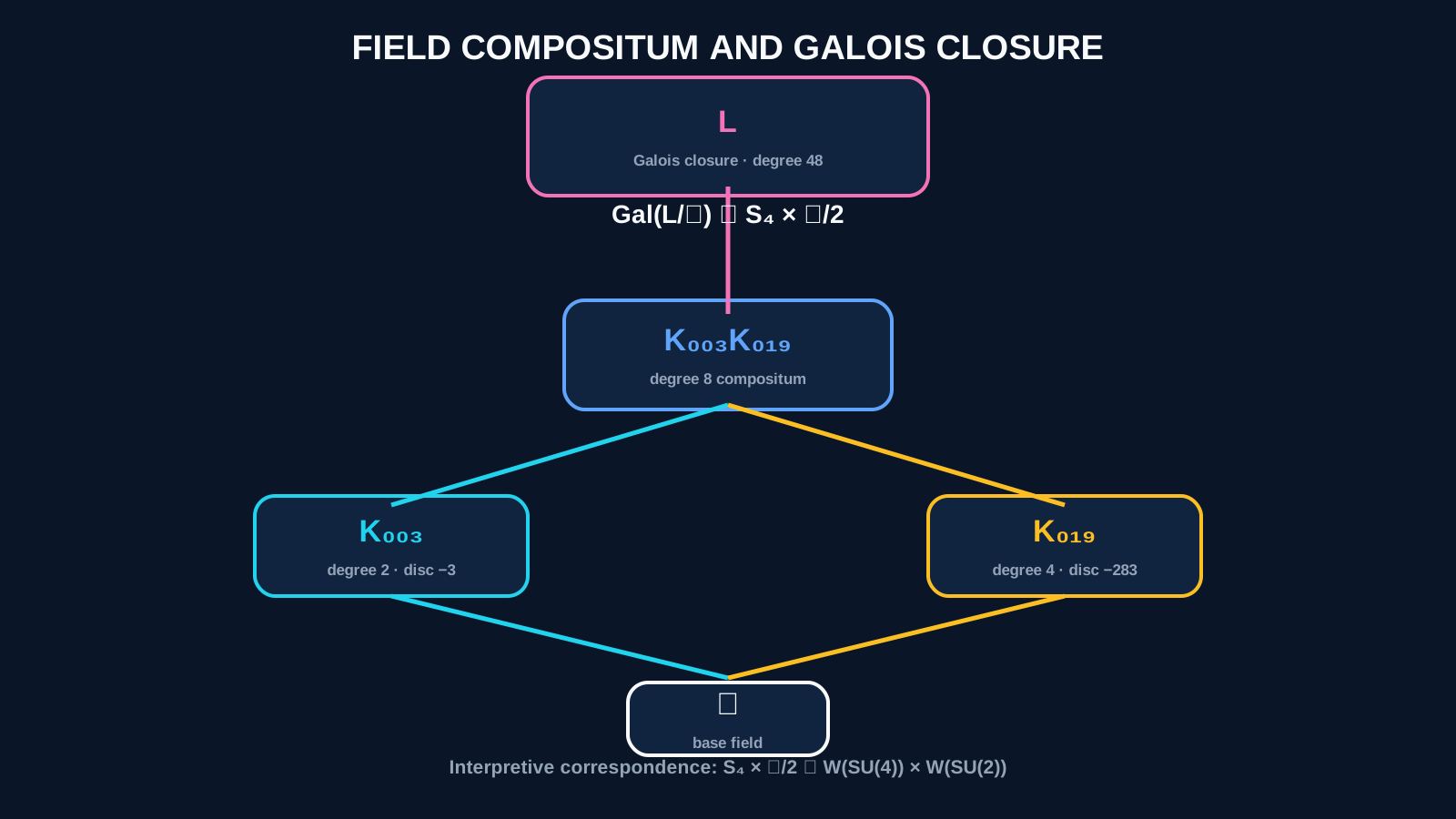
The dual surgery identity m003(−2,3) = m019(2,1) = M_PMNS links the two SU(2) and SU(4) parents. Their compositum has Galois group S₄×ℤ/2 = Weyl(SU(4)×SU(2)_L), the Weyl group of the Pati–Salam gauge sector.

Proved Results

The compositum of all four cusp fields (K_m003 disc=−3, K_m010 disc=−7, K_m006 disc=−59, K_m019 disc=−283) is Galois over ℚ with Gal(L/ℚ) ≅ ℤ/2×S₄×ℤ/2×S₃, order 576 — the full direct product of the four individual Weyl groups Weyl(SU(2)_L)×Weyl(SU(4))×Weyl(SU(2)_R)×Weyl(SU(3)_C), the complete Pati–Salam-plus-color gauge structure. Proved via mutual linear disjointness (pairwise disjoint ramified-prime supports {3},{7},{59},{283} force triviality of any common subfield by Minkowski's theorem), confirmed by exact degree computation at every step (24×6=144, ×2=288, ×2=576). The theorem is exact algebra; assigning the four factors to physical gauge sectors remains an interpretation, not part of the proof. The four manifolds m003, m019, m010, m006 are now identified exactly with their invariant trace fields; m010 is further distinguished within the ℚ(√−7) commensurability class by realizing the maximal cusp order, versus the non-maximal order realized by the volume-tied sibling manifold m009. See The 576-Element Breakthrough, CLAIMS_REGISTER.md entries 14–17.
Gal(τ_m003)≅ℤ/2≅Weyl(SU(2)), Gal(τ_m006)≅S₃≅Weyl(SU(3)), Gal(τ_m019)≅S₄≅Weyl(SU(4)). Verified at 300-bit precision; residuals below 10⁻⁸⁵.
Third manifold candidate (June 10 2026) — unverified, downgraded Aug 2026. m206(1,2) was proposed as a third torsion class ("order-6 Eisenstein torsion") extending PMNS (order 2) and CKM (order 4). Direct verification found H₁(m206(1,2)) = ℤ/5, not order 6, and the alternate eigenvalue-ratio reading of "order" does not hold either — m206's holonomy forces λ_b/λ_a to a cross-ratio of magnitude ≠1, not a root of unity. λ_b = −λ_a and mixing angle ~74° remain as observed; the order-6 / complete-taxonomy framing is retracted pending a correct account of what, if anything, m206 contributes.

CP phase is a manifold invariant (June 8 2026). 216 candidate word triples collapse under conjugacy to two primitive geodesic classes. Their phase resonance at θ* = −180° uniquely selects the ℤ/5 inverse pair (1,4) with 3.1× advantage over (2,3). δ = 195.91° vs PDG 197.0°. Zero free parameters. Manuscript RNTB-D-26-00299 submitted.

m003(−2,3) = m019(2,1) = M_PMNS. Verified to 15 significant figures via volume identity and explicit isometry check in SnapPy.
In K=ℚ(w), w⁴=w+1: the shapes z_A=w³=1−u₁, z_B=−w=u₁⁻¹, z_S=w⁻⁴=u₁⁴ form a period-3 orbit under T(z)=1/(1−z). Product z_A·z_B·z_S=−1. Proved by pure algebra.
vol(m019) = 3·D(w³) and vol(m178) = 4·D(w³), where D is the Bloch-Wigner dilogarithm. D(w³) = v₀ verified to 2×10⁻⁵¹.
For disc=−283 manifolds with longitude (a,b): δ(M)=min(|6a−19b|,|13a+6b|,|13b−19a|). If H₁≅ℤ then |H₁(M(π*))| = δ(M) exactly.
2·cosh(2m·log φ) = L_{2m} for all m≥1. Closed geodesics of length 4m·log φ have integer holonomy traces equal to Lucas numbers.
For the elliptic curve X₀(11) and the Farey tower primes p_k ∈ {11, 31, 61, 101, 151, 211, 281}: the condition a_p² − 4p ∈ −3ℤ² holds if and only if p = 31. Explicitly: a₃₁ = 7, a₃₁² − 4·31 = 49 − 124 = −75 = −3·5². This is the unique prime in the tower whose Frobenius eigenvalues lie over ℚ(√−3), forcing the order-5 character χ₅ of conductor 31 to twist the base Bianchi form at level 283 down to level 283×31 = 8773 (rather than 283×31²). Verified computationally; script: reproduce/verify_frobenius.py.
The dimension-2 Bianchi component at level 8773 has Hecke eigenvalues a_p(g) = a_p(X₀(11))·S_{k(p)}, where S_k = ζ₅^k + ζ₅^{−k} and k = dlog₃(p mod 31) mod 5. Writing a_p(g) = A + B√5, every non-trivial eigenvalue lies on exactly one of three rays: B = 0 (real axis), B = −A (slope −1), or B = +A (slope +1). The multipliers {2, 1/φ, −φ} are the real character sums of C₅; the |A|=|B| condition follows from the definition of φ. Self-referential: φ generates its own eigenvalue field ℚ(√5). Verified for all primes p < 300; script: reproduce/verify_three_ray.py.
For M_CKM = m006(−5,2): (1) Fricke collapse: tr(ρ(ab)) = tr(ρ(a)) on the reduced geometric component, now confirmed exactly (not just numerically) via quotient-ring linear algebra on the character variety — z−x is a genuine order-2 nilpotent at the scheme level, but vanishes exactly at the actual geometric point, forcing a finite trace quotient. (2) The trace quotient graph has exactly 122 distinct trace classes at word length ≤ 6. (3) ITF generator identity: tr(ρ(a)) = −α, where α is the primitive element of the invariant trace field K₁₀ = ℚ[t]/(t¹⁰ − 7t⁸ − 4t⁷ + · · ·), disc = −271488204251, sig = (8,1), Gal = S₁₀. The signature (8,1) — eight real places, one complex pair — is the arithmetic selection criterion for m006(−5,2) as the CKM manifold. Script: reproduce/verify_trace.py.
The golden ratio φ = (1+√5)/2 enters the HFG fermion mass lattice m ≈ m_e · φ^{q/4} through a proved chain of arithmetic implications: 31 → χ₅ → ζ₅ → ℚ(√5) → φ. The prime 31 is singled out by the single Diophantine identity a₃₁² − 4·31 = −3·5² (Theorem A). The character χ₅ of order 5 produces fifth roots of unity ζ₅; their real combinations ζ₅^k + ζ₅^{−k} lie in ℚ(√5); and φ generates ℚ(√5) over ℚ. φ is not a free parameter — it is forced by the arithmetic of p = 31. Post: The Golden Ratio Has an Automorphic Origin.
Same-search null (p ≤ 0.005): 200 random CKM-shaped matrices tested against m006(−5,2) using the same word-triple search achieve fitness no better than 0.146 (mean 0.288). The physical CKM matrix achieves 0.003989 — a strict outlier; one-sided Monte Carlo p ≤ 0.005. Census null: among 12 H₁=ℤ/5 manifolds scanned, m006(−5,2) ranks 6th by raw fitness — it is not selected by fitness. Arithmetic uniqueness: m006(−5,2) is the unique H₁=ℤ/5 manifold with ITF signature (8,1) in the full SnapPy closed census (948 candidates across 11,031 manifolds), verified by exhaustive enumeration; script: reproduce/signature_enum_test.py.

The Dual Surgery Identity — Figures

Supporting graphics for the dual surgery theorem above — also published with the Substack writeup.
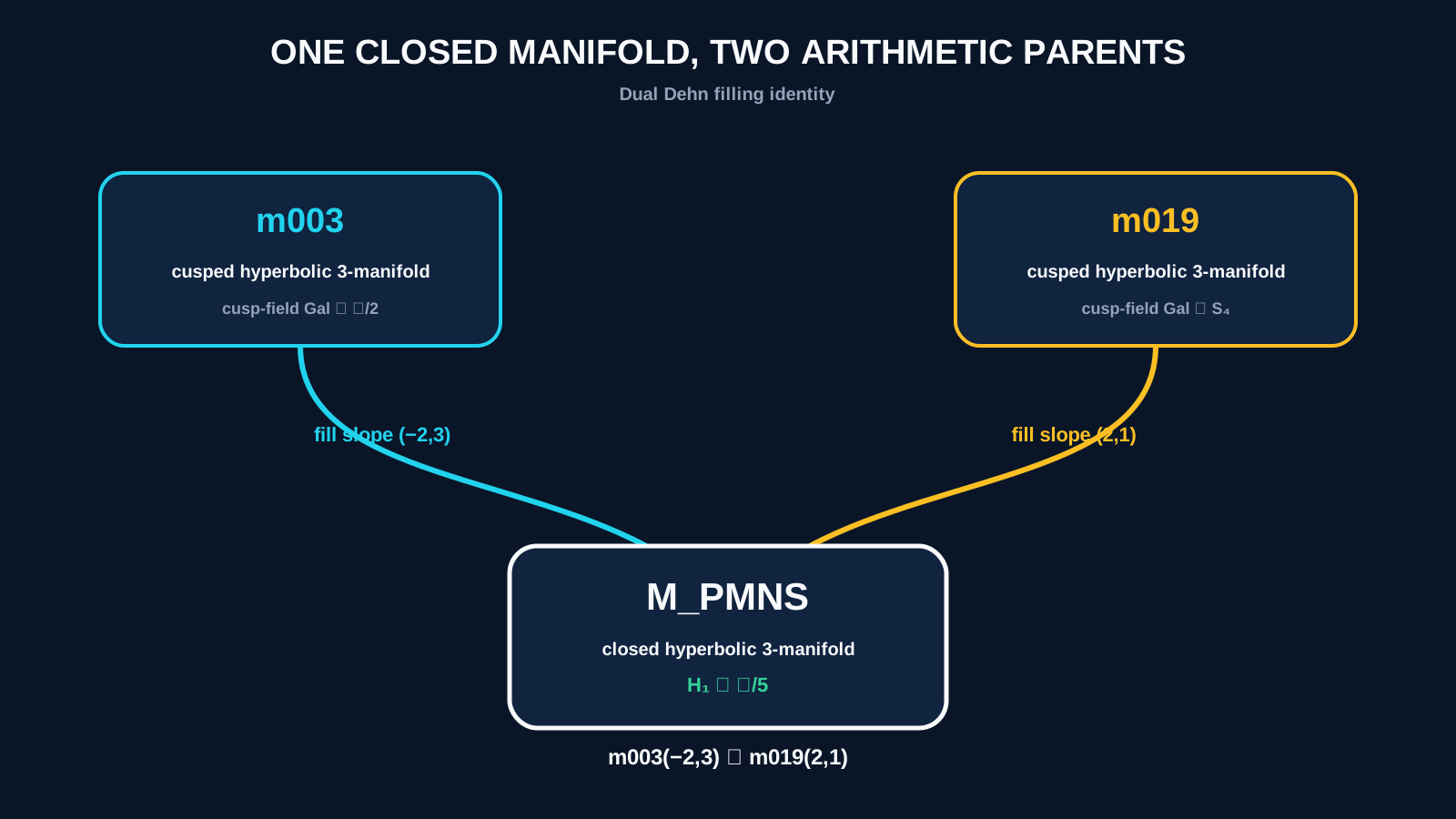
One closed manifold, two arithmetic parents
One closed manifold, two arithmetic parents — m003(−2,3) and m019(2,1) both fill to M_PMNS.
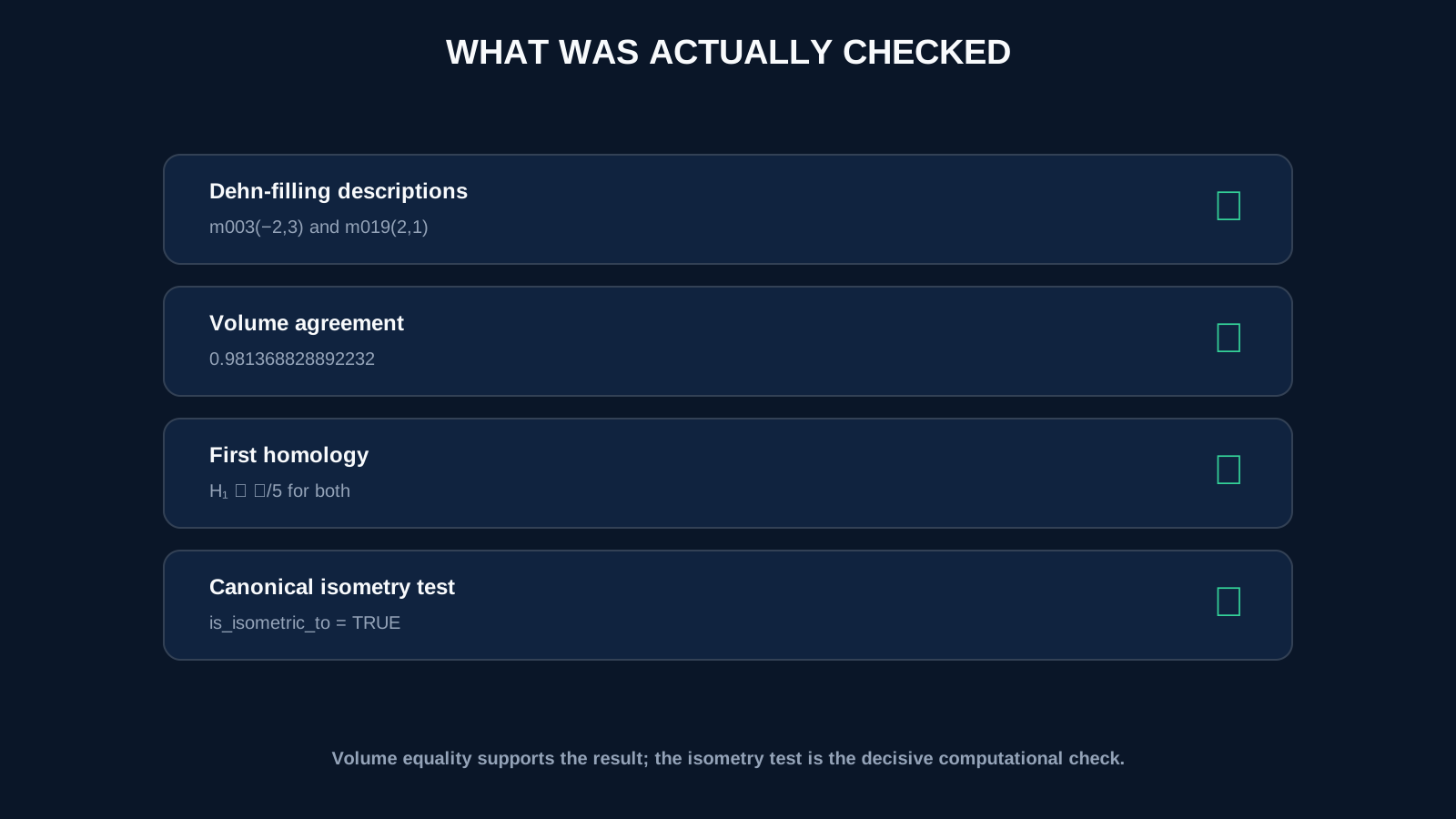
What was actually checked — volume, homology, isometry
What was actually checked: Dehn-filling descriptions, volume agreement (0.981368828892232), first homology (ℤ/5 for both), and SnapPy's is_isometric_to = True.
What survived verification, and what did not
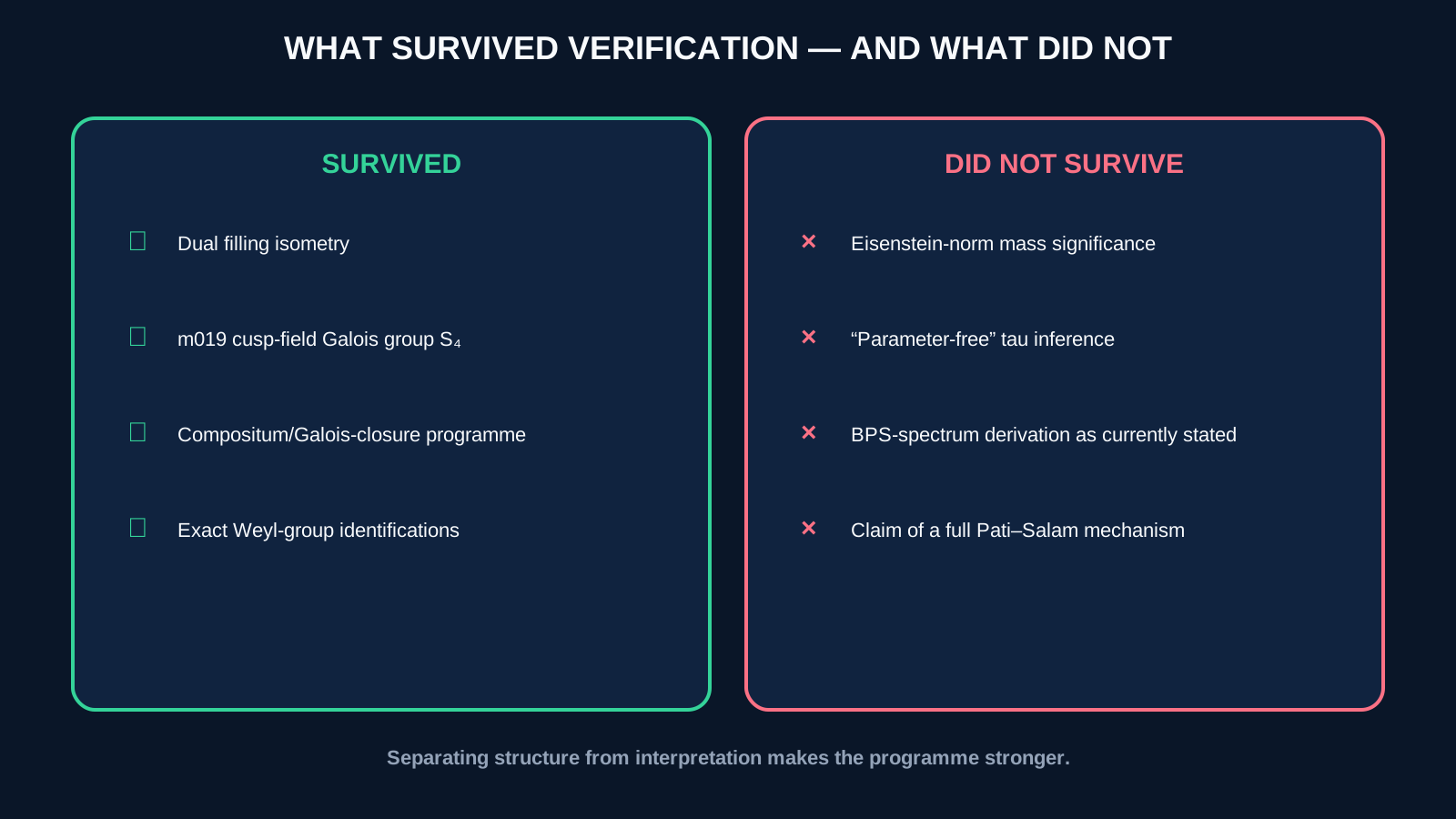
What survived independent verification, and what did not — the dual filling isometry and Galois closure hold; the Eisenstein-norm mass claims and full Pati-Salam mechanism do not.
Field compositum and Galois closure
Field compositum and Galois closure: K₀₀₃ (degree 2) and K₀₁₉ (degree 4) compose to degree 8; the Galois closure has degree 48, Gal(L/ℚ) ≅ S₄ × ℤ/2.

Publications & Preprints

Synced to ORCID 0009-0006-4550-2663, Aug 2026.
New Post · August 22 2026
The 576-Element Breakthrough: How Four Arithmetic Manifolds Assemble the Gauge Structure of Nature. Four curved spaces, one exact theorem: the arithmetic of hyperbolic geometry assembles the complete gauge symmetry of the Standard Model — proved, not guessed. The full four-field Galois product theorem, Gal(L/ℚ) ≅ ℤ/2×S₄×ℤ/2×S₃, order 576.
Substack Post → All Posts →
Candidate result · under investigation, downgraded Aug 2026
Third Manifold Candidate. m206(1,2) was proposed as a third torsion class ("order-6 Eisenstein torsion") alongside PMNS (order 2) and CKM (order 4). Direct verification found H₁(m206(1,2)) = ℤ/5, not order 6, and the order-6 / complete-taxonomy framing is retracted pending a correct account. λ_b = −λ_a and mixing angle ~74° remain as observed.
Article IV → Article III → Explorer →

All Substack Posts

The HFG Dispatch, in full — synced from the live archive, Aug 2026.

Popular Articles

Visual, interactive explainers — no equations required.

New · Aug 2026
The Shape of Flavor
Why matter comes in threes: the full HFG story from the Cabibbo angle to the Galois–Weyl correspondence, with an honest evidence ladder for every claim.
Read →
Article I
The Smallest Possible Universe
Why does the minimum-volume hyperbolic 3-space know the mass of the muon? Animated Poincaré disk, live orbit visualization, volume quantum ladder.
Read + Explore →
Article II
Why Hyperbolic Space Looks Impossible
8 interactive modules: grid morph, fish tank, triangle angle deficit, geodesic challenge game, tessellation explorer, area growth explosion.
Play + Learn →
Article III · June 2026
The CP Phase Is a Manifold Invariant
216 word triples collapse to two geodesic classes. The ℤ/5 inverse pair (1,4) is selected by phase resonance at −180°. Zero free parameters.
Article IV · June 2026, downgraded Aug 2026
A Third Mixing Matrix?
m206(1,2): near-maximal mixing ~74° observed. The order-6 torsion / complete-taxonomy reading is retracted — verification found H₁ = ℤ/5, not order 6.
Research Article
The Tetrahedral Polynomial Is a Norm
The shape polynomial of the Meyerhoff manifold is an algebraic norm. Seven-check SageMath proof, unit orbit, Bloch–Wigner identity. Interactive animations.
Read + Interact →

Reproduce

All results are reproducible using SnapPy and SageMath. All scripts run in WSL with conda activate sage and print PASS/FAIL per claim.

# Theorem A: Frobenius discriminant — p=31 is unique (< 10 seconds)
python3 reproduce/verify_frobenius.py
# → THEOREM A: VERIFIED [PASS]

# Theorem B: Three-ray eigenvalue structure (< 30 seconds)
python3 reproduce/verify_three_ray.py
# → THEOREM B: VERIFIED [PASS]

# Theorem C: Fricke collapse, ITF generator, 122-node quotient (< 5 min)
python3 reproduce/verify_trace.py
# → THEOREM C: VERIFIED [PASS]

# Statistical validation: same-search null p=0.005 (< 10 minutes)
python3 reproduce/census_null_test.py
# → TAIL -- m006(-5,2) is special (p=0.005)

# Arithmetic uniqueness: m006 is unique H1=Z/5 manifold with ITF sig=(8,1)
# Phase 1+2 ~2 min; Phase 3 fitness comparison ~15 hours
python3 reproduce/signature_enum_test.py
# → Phase 2: 1 sig=(8,1) manifold found (m006(-5,2))
import snappy
# Verify dual surgery
M1 = snappy.Manifold("m003(-2,3)")
M2 = snappy.Manifold("m019(2,1)")
print(M1.is_isometric_to(M2))   # True

# Verify Bloch volume quantum
v0 = float(M1.volume())
print(float(snappy.Manifold("m019").volume()) / v0)  # 3.0
print(float(snappy.Manifold("m178").volume()) / v0)  # 4.0

# Verify unit orbit in K=Q(w), w^4=w+1
from sage.all import NumberField, QQ
K = NumberField(QQ['x'].gen()^4 - QQ['x'].gen() - 1, 'w')
w = K.gen()
u1 = 1 - w^3
print(-w == u1^(-1))   # True
print(w^(-4) == u1^4)  # True

github.com/drmlgentry/hyperbolic-flavor-geometry
PyPI: latticefit

The HFG Dispatch
Monthly dispatches from the frontier

New results, open problems, and honest frontier science. Free to read. Paid subscribers get the computational notebooks and proofs.

Subscribe Free →
Resonance Explorer → $9 / month